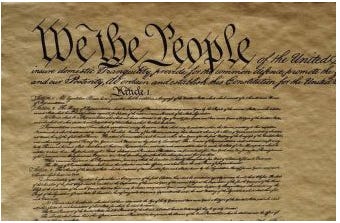
No state shall...

Despite being a relatively short document, most Americans are unfamiliar with many parts of the U.S. Constitution. In general, we know more about the Amendments that came after ratification than the original body. Even people who can cite the subjects of the different Articles, will pause when I bring up what I call the “No state shall…” section.
Yet, that section was a turning point in American history. After the War for Independence, average Americans wanted more rights than the leadership was ready to commit to on paper. So, after the war, veterans and local political leaders set about drafting individual state constitutions. Every state created a different variation on the theme of representative government, including expanded political rights.
This experiment in a decentralized, small national government republic only lasted three years before it started unraveling.
The Treaty of Paris, which ended our revolution, was signed in 1783 and Shays’ Rebellion broke out in 1786. Shays’ Rebellion, an insurrection against Massachusetts’s state government, made the men who held the colonies together during the war worry the new nation was on the verge of widespread armed rebellion.
To stop a real revolution from gaining momentum, they met to discuss revising the war-time charter, known as the Articles of Confederation, that was continuing to define the national government.
When the convention to review the Articles began in May of 1787 a brief discussion about amendments ensued, but it was evident the attendees wanted more. So, George Washington, who had been elected president of the convention, swore the room to secrecy and the work to draft our constitution began.
These men were not starting from scratch; all were very familiar with England’s system of parliamentary government and well read in Enlightenment political philosophy. It’s easy to see how closely our new governing system mirrored England’s. Monarchy, Parliament with two houses, upper and lower, and a judiciary. President, Congress with two houses, upper and lower, and a judiciary.
The convention debates were, therefore, less focused on form, and more on how each branch would function individually and in relation to each other. This was especially true when it came to the distribution of power.
You can almost hear the debates when you read the original document. Slavery is obviously included and protected, yet the words slave and slavery are absent. That was a choice. The Senate’s ability to veto anything coming out of the House of Representatives is stealthy cloaked behind all the powers given to the people’s house.
Realizing the public’s ire would flare in response to the secrecy used to hide their activities, the convention participants wisely included an amending process. The people would have the power to tweak and add to the document once it was ratified and operational. The people would have a say, but after ratification.
Within this framework, we rarely discuss the radical nature of Article I Section 10. Article I establishes Congress starting with the House of Representatives and then the Senate. Section 8 provides a detailed list of Congressional powers. You would think that would be sufficient, but no, Section 10 begins with the stark words “No state shall…” It then clearly takes power away from the states and gives it to the new, stronger national government.
Section 10:
No State shall enter into any Treaty, Alliance, or Confederation; grant Letters of Marque and Reprisal; coin Money; emit Bills of Credit; make any Thing but gold and silver Coin a Tender in Payment of Debts; pass any Bill of Attainder, ex post facto Law, or Law impairing the Obligation of Contracts, or grant any Title of Nobility.
No State shall, without the Consent of the Congress, lay any Imposts or Duties on Imports or Exports, except what may be absolutely necessary for executing it’s inspection Laws: and the net Produce of all Duties and Imposts, laid by any State on Imports or Exports, shall be for the Use of the Treasury of the United States; and all such Laws shall be subject to the Revision and Controul of the Congress.
No State shall, without the Consent of Congress, lay any Duty of Tonnage, keep Troops, or Ships of War in time of Peace, enter into any Agreement or Compact with another State, or with a foreign Power, or engage in War, unless actually invaded, or in such imminent Danger as will not admit of delay.
A redistribution of authority was, therefore, a main purpose of the original constitution, which clearly defines the powers and limitations of Congress and the states. This is why Article II, which creates the Executive Branch, is so short. Most of the power was given to Congress, with the states retaining considerable influence.
The desire to define the Executive Branch with specificity was low because the president was not expected to exercise the types of power allocated to Congress and the states. It was also assumed Congress would jealously guard its power and not cede it to the states or to the other branches of government.
How did we end up where we are now?
The founders believed our nation would be too diverse in thought and interests for political parties to take hold, and then they started the first two political parties not long after the states ratified the Constitution.
The variable of partisanship started post ratification and was fully developed by the time the Federalists in Congress passed the Alien and Sedition Acts in 1798 to make it a criminal offense to criticize the Federalist President John Adams. The opposition party, the Democratic Republicans, was criticizing Adams over his decision to involve the nation in a war without proper congressional approval.
We therefore have evidence that partisanship overriding the separation of powers dates back to the beginning of our country, but the parties took control of our government and decided to not limit themselves by addressing this problem.
If we want to address the problem, we should look to the Constitution itself for clues on how to ensure that Congress guards its power, that the President does not overstep his/her powers, and that the courts are not continually adjudicating whether the President does or does not have a power. We should look at Article I Section 10.
An amendment that either requires Congress to not cede its power or defines what the President shall not do would fall in line with the original document. An amendment starting with “Congress shall not..” or “The President shall not..” would be no different from “No state shall…”
We needed “No state shall…” in 1787. We may need “The Congress shall not cede any power to either of the two other branches;” or “The President shall not usurp the power of the other two branches” now. It may be time for the people to exercise our power to tweak.